History Unit 3 Assessment
The Peloponnesian War between Athens and Sparta, which lasted 27 years, weakened Ancient Greece’s economy and military, as shown by the Corinthian Helmet. During the war, the Plague of Athens further weakened Athens by killing approximately a quarter of its population, evidenced by the Plague Lekythos. These factors led to Ancient Greece’s city-states ultimately losing their independence following the conquest of Macedonia’s King Philip II, represented by the Bronze Arrowhead of Philip.
Corinthian Helmet
The Corinthian Helmet is a type of helmet, possibly created in the city-state of Corinth, which would have been worn by Greek soldiers, called hoplites, to protect their heads during battle. It would have been worn alongside armour on their chest and legs. This type of helmet would have been worn specifically by a hoplite with a higher social standing because it would have been expensive to construct. These helmets were made during the height of the Ancient Greek military. This particular helmet also has puncture marks likely from a spear or javelin during battle.1
These helmets declined in use before the Peloponnesian War, which lasted for 27 years between Athens and Sparta, and were gradually replaced by the Attic helmet.2 The economy suffered as a result of this long war,3 which marked the end of the height of the Ancient Greek military as well as their tradition of having a strong military. These factors contributed to the decline of Ancient Greece and represented a negative turning point in history. Ancient Greece was left vulnerable since its military didn’t have enough time to recover before the Macedonian invasion.4
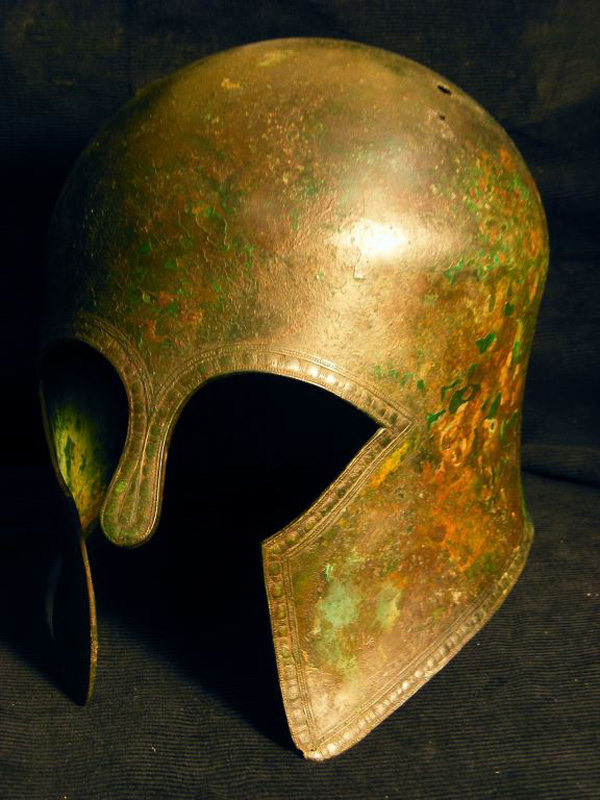
Figure 1: Corinthian helmet.
Source: National Museum of Ireland. "Corinthian Helmet." Photograph. National Museum of Ireland, Dublin. Accessed July 9, 2026. https://www.museum.ie/en-IE/Collections-Research/Collection/Documentation-Discoveries/Artefact/Corinthian-Helmet/e174192e-1ca4-4d34-91f3-899e4d3c1f90.
Plague Lekythoi
The lekythos is a small jug used to carry oil. It was also sometimes used for burial purposes and filled with perfumed oil and placed near tombs to offer to the dead person or the gods.5 This artifact was discovered with nearly 1,000 tombs during the construction of a new subway line.6
During the Classical Age of Greece, there was traditionally a ceremony that was held before a dead body was buried in a grave. The body would have been washed and rubbed with olive oil, then dressed in white garments, and placed on a bed where relatives and family could view and mourn for a day or two. However, the plague changed this because the mass grave had many bodies placed closely together with far fewer burial offerings than the excavators expected, which were cheap and common. Some of these rituals may date back to the Greek Dark Ages or even earlier.7
This artifact represents a major turning point in the decline of Ancient Greece because the Plague of Athens killed approximately a quarter of Athens’ population. The plague was likely caused by overcrowding in Athens, which was partly due to the Peloponnesian War between Athens and Sparta that centralized the rural population into the centre of the city behind the tall, fortified walls. The plague weakened Athens and caused a temporary stall in the war, where neither side advanced during the plague years.8 The plague was devastating and lasted 3 years.9
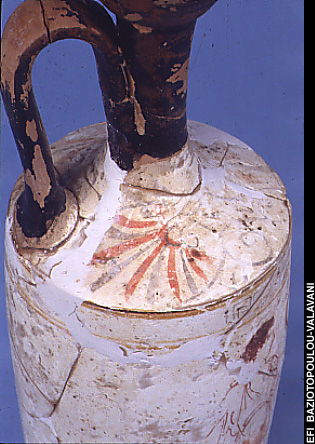
Figure 2: A white-ground lekythos (oil flask).
Source: Baziotopoulou-Valavani, Efi. "White-Ground Lekythos Recovered from a Mass Grave." Photograph. Courtesy Efi Baziotopoulou-Valavani.
Bronze Arrowhead “of Philip”
This arrowhead, which is made of bronze and has an inscription reading “of Philip” in Greek, represents Philip II’s conquest that captured the city-states of Ancient Greece.10 During the Archaic Age, which was more than 300 years before the conquest, Ancient Greece was divided into many different city-states, called poleis.11 However, during Philip II’s conquest at the Battle of Chaeronea, Ancient Greece became no longer composed of independently governed city-states, but was now part of the Macedonian Empire ruled by Philip II and then later Alexander the Great. This was a sudden change and was a turning point in history because now the city-states were forced to join a confederacy led by Philip II, where they had to provide soldiers, money, and other resources when demanded.12 As a result, Ancient Greece declined in power because the city-states no longer had independence.
The battle began in 338 BCE when Philip II met the alliance, led by Athens and Thebes, in the Cephissus Valley. Philip II used a trick where he pretended that he had developed a sudden fear and retreated his army; this lured the Athenians to charge at him. This move separated the Athenians from their allies and created a gap in the formation, which allowed Alexander the Great to widen the gap.13
This arrowhead shows Ancient Greece’s sudden and final decline by losing independence in a single battle after being weakened by the Peloponnesian War and the plague of Athens. This was a negative change since city-states were no longer independent and happened quickly.

Figure 3: Inscribed Arrowhead.
Source: Harvard Art Museums. "Inscribed Arrowhead of Philip." Photograph. © President and Fellows of Harvard College. Harvard Art Museums, Cambridge. Accessed July 9, 2026. https://harvardartmuseums.org/collections/object/303999.
Together, these three artifacts show that the decline of Ancient Greece was not caused by a single event but by a combination of factors, starting with the Corinthian Helmet showing how the war impacted and exhausted Ancient Greece over 27 years, followed by the Plague Lekythos showing how the Plague of Athens further weakened Athens, and finally by the Bronze Arrowhead showing how the city-states of Ancient Greece lost their independence.
Footnotes
- National Museum of Ireland. “Corinthian Helmet.” Accessed July 9, 2026. https://www.museum.ie/en-IE/Collections-Research/Collection/Documentation-Discoveries/Artefact/Corinthian-Helmet/e174192e-1ca4-4d34-91f3-899e4d3c1f90 . ↩
- Pitt Rivers Museum, University of Oxford. “Bronze Helmet from Greece.” Accessed July 9, 2026. https://web.prm.ox.ac.uk/weapons/index.php/tour-by-region/oceania/europe/arms-and-armour-europe-162/index.html . ↩
- Mark, Joshua J. “Peloponnesian War.” World History Encyclopedia. Accessed July 9, 2026. https://www.worldhistory.org/Peloponnesian_War/ . ↩
- Encyclopedia Britannica. “Battle of Chaeronea.” Accessed July 9, 2026. https://www.britannica.com/event/Battle-of-Chaeronea . ↩
- Hunt Museum. “Ancient Greek Vessels/Lekythoi.” Accessed July 9, 2026. https://www.huntmuseum.com/stories/objects-in-focus/ancient-greek-vesselslekythoi/ . ↩
- Archaeology Magazine. “Kerameikos.” Accessed July 9, 2026. https://archive.archaeology.org/online/news/kerameikos.html . ↩
- Don Nardo, The Greenhaven Encyclopedia of Ancient Greece (Farmington Hills, MI: Greenhaven Press, 2006), 84-85. ↩
- EBSCO. “Plague of Athens.” Accessed July 9, 2026. https://www.ebsco.com/research-starters/history/plague-athens . ↩
- Mark, Joshua J. “The Plague at Athens, 430–427 BCE.” World History Encyclopedia. Accessed July 9, 2026. https://www.worldhistory.org/article/939/the-plague-at-athens-430-427-bce/ . ↩
- Harvard Art Museums. “Inscribed Arrowhead.” Accessed July 9, 2026. https://harvardartmuseums.org/collections/object/303999 . ↩
- Don Nardo, The Greenhaven Encyclopedia of Ancient Greece (Farmington Hills, MI: Greenhaven Press, 2006), 275-276. ↩
- Nardo, The Greenhaven Encyclopedia of Ancient Greece, 262-263. ↩
- Nardo, The Greenhaven Encyclopedia of Ancient Greece, 72-73. ↩